

cross-posted from: https://scribe.disroot.org/post/11349801
…
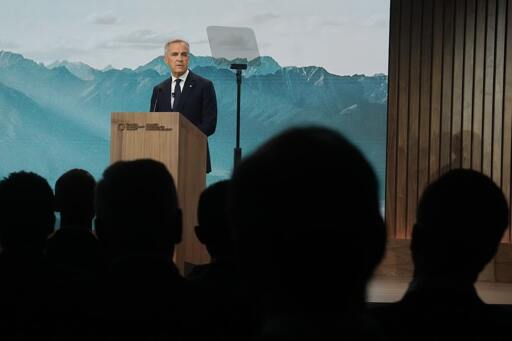
The federal government of Canada will help to fund “a sovereign broadband backbone that connects Canadians from coast to coast to coast, with more direct and secure links to Europe and Asia,” Prime Minister Mark Carney announced.
A “broadband backbone” is the high-capacity core of the internet network that carries traffic between cities and countries. Speaking with reporters later, Mr. Carney said the backbone would also include connections to the Arctic.
…
Representatives for Canada’s major telecom companies supported Mr. Carney’s announcement … As Mr. Carney’s government continues to seek alternatives to reduce dependence on the United States, calls have grown to develop more networking infrastructure that would avoid routing Canadian data through U.S. internet exchanges, thereby exposing that data to potential surveillance.
…
Researchers at the University of Toronto and York University studying the journey taken by data between two points in Canada have found that, among their data sets, about a quarter of those journeys routed through American interchanges, exposing that information to access by the U.S. National Security Agency.
…
Mr. Carney did not provide further details about the broadband project. However, discussions about the ownership and financing model for the project are currently being held between telecom companies and the Major Projects Office, according to two sources with knowledge of the matter.
…
Awesome! Don’t a few undersea cables already route through Canada? That should make it easier!
Courtesy @derp@dbzer0.com
There are actually surprisingly few intercontinental submarine cables with an end-point in Canada and all of the ones to Europe go via Britain which, as shown by the Snowden Revelations, do bulk surveillance on everything going via the cables with end-points in Britain and pass that data to the US.
At first sight there seem to be only 2 “clean” submarine cables with end-points in Canada, one to Greenland and one to Japan.
Nova Scotia has a few and that one heading to Greenland too, right? It’s not perfect but it’s a good starting point and it’ll take only a few years to a decade to build these out. But your point about the eyes is valid.
But that’s not what they’re trying to prevent here, I think. They’re just trying to make it so that Canada is not dependent on US infra.
Busineswise, it makes sense that the one to Greenland when it was built did not need much capacity so it or at least its endpoints and routing in Canada and Greenland were probably not really designed to be able to take over a significant part of the traffic that goes to Europe via the US.
I might be wrong, it just makes sense to me for that to be the case from a systems design logic.
I thought that was the one that takes the financial data across at super speed? The one that shaved off a few milliseconds and it’s estimated that its value to financial ppl is in hundreds of millions per year?
I have no idea since I’m not Canadian.
Technically speaking, the bandwidth necessary for algorithmic trading is nowhere near that needed for bulk Internet traffic and generally in electronics (in this specific situation I’m thinking mostly of routing, though maybe it also applies whatever is used for maintaining long distance signal integrity in fiber, plus possibly single-mode vs multimode in fibre has transmission speed implications) if you’re trying to get the greatest speed possible you’re not going to get as much bandwidth since at the bleeding edge the optimizations done for one tend to have as tradeoff less of the other.
That said, this is all informed speculation (I worked in Finance, and have an EE Degree) rather than specific knowledge of that situation, so take it with a big pinch.
UBC has several big pipes, I’m sure there’s some on the East Coast too