A Globe and Mail investigation reports Alberta separatist figures proposed giving the U.S. access to fresh water and oil royalties in exchange for help with independence. Another separatist leader disputes it, and the investigation also reveals a Calgary meeting with Republican operatives from Michigan.


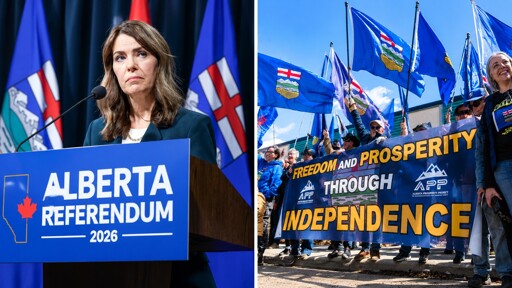
They don’t need it to be “technically” allowed by esoteric Canadian laws, or areas discussed primarily by law fangirls that find joy in digging through whether a comma in a sentence changes the meaning of a law or whatever.
They just need enough public support, optics data points and soundbites, to justify more forceful action from the Alberta government, and/or the US government.
It’s sorta like the trade dispute. The American side exclusively looks at the goods trade portfolio, and exempts the services trade numbers, because if you look at the ‘whole’ trade scenario, America is way “ahead” of Canada given how they frame trade deficits. They do that to have a data point / sound bite, simple concept, for the idiot base to latch on to and support their nonsense trade actions against Canada. They use that data point as the “real” justification for their actions, while implementing penalties based on totally bullshit official reasons (eg. “Fentanyl! We need tariffs because of Fent!!”). The “ends justify the means” crowd can then get on board, because even if the official reasons are clearly wrong/illegal/unethical, they think the ‘trade imbalance’ emergency warrants taking any action possible to address it.
If Alberta votes strongly in favour of separation, American fascists will feel emboldened to aid Alberta, and punish Canada. Technicalities of the law will not matter.
I looked it up. It is loosely write as you said, however that swings both ways.
There was something else I did notice. The provinces have to agree to the constitutional amendment required to allow Alberta to separate. All it takes is one Premier to say that the referendums were not done democratically. They would have to go through everything that was done in bad faith in front of parliament and be willing to pay the massive political cost of doing so.
The thing that is actually impossible is getting the First Nations to agree to leave Canada. I would guess they have claim to more than 75% of the land, leaving Alberta to be a fraction of the size it once was. Those treaties are a goddam mess and can basically never be modified.
I’d dispute this a bit. Treaties exist and are a concern because Canada tries to do its best to honour them. They are paper, and are a social construct.
A fascist/Trumpian administration will handle treaties in the same fashion as they handled the Gordie Howe Bridge situation: treaties, contracts and so on are paper controls, meaning they lack inherent enforcement, and can be torn up at any time should either party choose to do so, and have the military/power to enforce their side’s interests. Canada as a nation has had that power historically, but has not typically exercised it.
In addition to potentially just ignoring First Nation treaties, a fascist/authoritarian administration could take other broad-stroke steps to impact the treaty process – this is made even more plausible when you look at what Alberta’s other 9 questions are about on their referendum. There’s a chunk of ‘stuff’ in the treaty-process that’s essentially been ‘added in’ by the law society over the years – all of that could get opened up / changed by an authoritarian government deciding the courts got it wrong, and legislating a different course.
For example, the concept of “Shared Exclusivity” didn’t really exist in most treaties. The Charter/Constitution also primarily talk about three specific designated groups. Removing Shared Exclusivity would eliminate land-claim conflicts, drastically reduce the size of land claims, and could easily be justified for removal on progressive grounds even – it was a law society decision interpreting the charter/constitution that was made in the late 1900s, that treats all First Nations as a unified whole, even though many of these nations actually raided each other for slaves / were not friends. It’s like saying Rome had “Shared Exclusivity” of Egypt, because they showed up for a few years and took some slaves from Egypt. Focusing on the three designated groups, the government could re-tool its negotiations to just worry about those three groups from the govts side – you can’t realistically expect the whole government to bend over backward trying to treat with a band that’s less than 500 people. So “First Nations” need to have a representative/singular structure for negotiations, and if they can’t sort it out on their side of the negotiation table, “too bad for them, fascists advance!”. And to reiterate an earlier point – even if these steps may seem dodgey, they could enact them with the support from the people based on the ‘real’ reason being 'democratic principles must be paramount in a democracy": the ends justify the means.
Canada gets shat on constantly by First Nations. They use terms like “Colonial” as pejoratives with gusto, because Canadians are too polite to point out its a slur/racist – it’s so entrenched/accepted to use it as such, that it’s even done in marketing campaigns for schools that are seeking to “de-colonialize” things… Canada’s been pretty good, relatively speaking, compared to other nations in regards to local native populations. But it’d be silly to pretend like these issues couldn’t be handled differently, in ways that are far less charitable to First Nation people.
And I think First Nations understand this at some level, which is why despite all their anti-Canada sentiment, they want to remain in Canada. Because, yes, if another power comes in, they won’t give a shit about treaties.