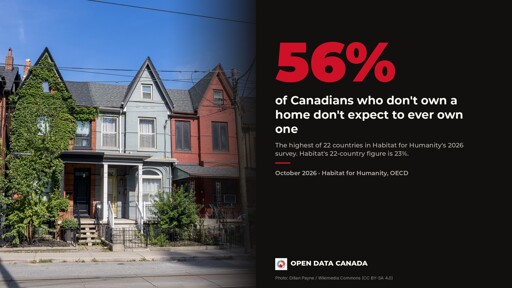
56% of Canadians who don't own a home don't expect to ever own one, the highest of 22 countries in Habitat for Humanity's 2026 survey. Globally it's 23%.
Others answered you with some uncritical, kneejerk explanations.
Yes, private property is a root cause since like, this is a capitalist system, but the idea of it being exceptionally “foreign,” or more exclusionary than comparable markets is ignoring why it is like this in Canada specifically. There’s a lot of long term contributors like suburban sprawl city planning without the same population explosions like in the US, conflicting interests and power dynamics between provincial and municipal govts that inhibits some practical regulatory responses, and a gradually disparate quality and cost of living as neoliberal politics eroded social welfare programs (healthcare, postsecondary education grants/ institutional funding, unemployment and disability support).
However, the big one that people credit for the specific boom of the past twenty years is actually how the current PM, Mark Carney, responded to the '08 financial crisis during his tenure as the Governor of the Bank of Canada. While Canada fared much better than other G7 states, it did so by reducing prime and encouraging spending, which meant that real-estate was a more reliable asset than usual under those circumstances; certainly more than businesses or labour. Since people were already severely underpaid in a system with less public supports and exponentially increasing infrastructure costs, this market bubbled with the Canadian economy balanced ontop of it (y’know, more than before).
Mix all that with Canada’s low and concentrated population, fewer career opportunities outside of those population centers, and neoliberalized framework, you have a system that relied on an unsustainably expensive real-estate market where regulators’ material interests (either individually or systemically since property value effects property tax and therefore city budgets) made it pretty much impossible for any bottom-up change to be implemented before a massive shift in material security for middle class workers.
So uh, guess when prime went up again and when more people started actually talking about how fucked the housing is here, and guess why it all came to a head around 2020.
Circling back to thank you for the candid, in-depth response.
Canada and Australia aren’t all too dissimilar, it seems.
Rampant speculation was ultimately responsible for our similar housing bubble here in Australia too. It’s taken a lot of political fortitude to introduce the necessary policies here to try and thread the needle to keep housing affordable for the population, without completely cratering values and destroying millions of owner-occupiers.
We are very lucky that our primary Conservative Party largely self-destructed last election cycle, and is too busy fighting off an insurgent far-right party to lose any threat to our (notionally) left Government.
I truly hope you guys can find your own safe path out of that minefield.
I’m honestly pretty ignorant of Australian politics of the last five years (the dumpster fire smoke makes kt kind of hard to see out of here), but that does sound a bit more favourable. Our con party has secured their vote, but hasn’t won an election federally in over a decade now due to our voting system (the only thing I’m thankful for from it).
But, our neoliberal party has dominated federal politics in that time, and has only gotten more aggressive in its policies; especially now that they have a majority and don’t have to negotiate with the socdems anymore. The current PM I mentioned in my comment has run an admin that is slashing environmental and agricultural regulations, massively expanded public investment in private extractive enterprise, and has responded to growing shelter insecurity by expanding subsidies for property owners.
So, we’ll see, but I can’t imagine Canada is going to get much of a reprieve while the state desperately appeals to the EU as part of its plan to diversify away from US capital. Most Canadian voters are more concerned about what Trump says about Canada than they are about what policies are actually passed here; local politics has gotten a bump in attention, so maybe there’s that.


Others answered you with some uncritical, kneejerk explanations.
Yes, private property is a root cause since like, this is a capitalist system, but the idea of it being exceptionally “foreign,” or more exclusionary than comparable markets is ignoring why it is like this in Canada specifically. There’s a lot of long term contributors like suburban sprawl city planning without the same population explosions like in the US, conflicting interests and power dynamics between provincial and municipal govts that inhibits some practical regulatory responses, and a gradually disparate quality and cost of living as neoliberal politics eroded social welfare programs (healthcare, postsecondary education grants/ institutional funding, unemployment and disability support).
However, the big one that people credit for the specific boom of the past twenty years is actually how the current PM, Mark Carney, responded to the '08 financial crisis during his tenure as the Governor of the Bank of Canada. While Canada fared much better than other G7 states, it did so by reducing prime and encouraging spending, which meant that real-estate was a more reliable asset than usual under those circumstances; certainly more than businesses or labour. Since people were already severely underpaid in a system with less public supports and exponentially increasing infrastructure costs, this market bubbled with the Canadian economy balanced ontop of it (y’know, more than before).
Mix all that with Canada’s low and concentrated population, fewer career opportunities outside of those population centers, and neoliberalized framework, you have a system that relied on an unsustainably expensive real-estate market where regulators’ material interests (either individually or systemically since property value effects property tax and therefore city budgets) made it pretty much impossible for any bottom-up change to be implemented before a massive shift in material security for middle class workers.
So uh, guess when prime went up again and when more people started actually talking about how fucked the housing is here, and guess why it all came to a head around 2020.
Circling back to thank you for the candid, in-depth response.
Canada and Australia aren’t all too dissimilar, it seems.
Rampant speculation was ultimately responsible for our similar housing bubble here in Australia too. It’s taken a lot of political fortitude to introduce the necessary policies here to try and thread the needle to keep housing affordable for the population, without completely cratering values and destroying millions of owner-occupiers.
We are very lucky that our primary Conservative Party largely self-destructed last election cycle, and is too busy fighting off an insurgent far-right party to lose any threat to our (notionally) left Government.
I truly hope you guys can find your own safe path out of that minefield.
I’m honestly pretty ignorant of Australian politics of the last five years (the dumpster fire smoke makes kt kind of hard to see out of here), but that does sound a bit more favourable. Our con party has secured their vote, but hasn’t won an election federally in over a decade now due to our voting system (the only thing I’m thankful for from it).
But, our neoliberal party has dominated federal politics in that time, and has only gotten more aggressive in its policies; especially now that they have a majority and don’t have to negotiate with the socdems anymore. The current PM I mentioned in my comment has run an admin that is slashing environmental and agricultural regulations, massively expanded public investment in private extractive enterprise, and has responded to growing shelter insecurity by expanding subsidies for property owners.
So, we’ll see, but I can’t imagine Canada is going to get much of a reprieve while the state desperately appeals to the EU as part of its plan to diversify away from US capital. Most Canadian voters are more concerned about what Trump says about Canada than they are about what policies are actually passed here; local politics has gotten a bump in attention, so maybe there’s that.
Hope it works out for you guys too.