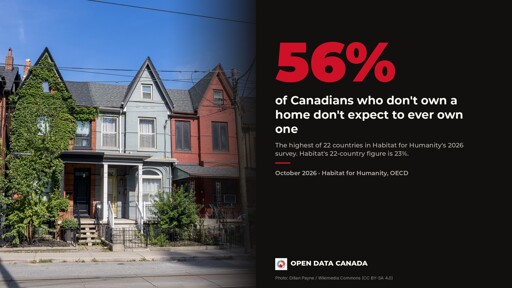
56% of Canadians who don't own a home don't expect to ever own one, the highest of 22 countries in Habitat for Humanity's 2026 survey. Globally it's 23%.
I did read your comment. You did not clarify what you meant. And I did not follow your link because it lacked context.
Nothing you’ve actually described is explicitly anti-property. In fact, some of what you’ve described - for example, rental regulations - is already in place and not actually helping. For instance it’s been illegal to discriminate against the disabled for decades. So they don’t. Instead, they discriminate against your credit score (not protected), whether or not you make a minimum income (not protected), whether or not you can obtain positive references (not protected), etc, all of which are more likely to affect the disabled.
One thing that would absolutely help would be rent control that includes vacancy control. Ontario used to have that. Without it, the current rent control legislation only protects me as long as I stay here. It doesn’t protect you if I move out and you move in.
it’s a link to the Maple’s list of property-owning MP’s, y’know, the people who legislate property and rental laws. In the context of my comment, it indicated that this isn’t because vaguely “the government” is an issue, but that landlords are in the government, and since this is a system oriented around property as a commodity and thus the precarity of shelter, that means that they are highly incentivized to increase the value of rental properties commercial or residential.
You’ll also notice that I’ve mentioned the ableism specifically, as it emblemizes the cruelty of a system where shelter insecurity is required for people to be “motivated” to work, and people who cannot work are never guaranteed sufficient welfare support. These are not disconnected things.
Read through these fully, as people disagreeing with you do not always do so for the reasons and in the ways that you assume they will.
I feel it important to point out that rental laws in particular are provincial, not federal. Which is why Ontario and BC were the only provinces to have any kind of vacancy control, and which is why Ontario removed it 13 years after BC did. So unless that link includes provincial members of parliament as well, what you’re showing me is a list of people who are benefiting from a system they don’t have the authority to change.
Also: Please try not to explain ableism to someone who’s experienced it. You’re not going to route out discrimination by making it illegal. That’s been done already. Changing the ownership structure of a property doesn’t make that property more likely to accept a disabled tenant. Neither does making shelter a right (the TL; DR of that argument: “you have the right to a house, but not this house”). Now, if you want to talk about improving the rental or homeownership situation for everyone, then we can absolutely have that conversation. If you want to talk about abolishing homeownership entirely, we’re going to have a different conversation.
Listen, I’m not gonna give this much more attention because I really don’t think you’re the kind of person who’s super open to criticism of this system.
So, yes, the federal government does have a massive influence on what is guaranteed to citizens, and definitely funnels money into specific subsidy programs that meets shelter insecurity with support for private capital. It does not need to be the sole regulator for shelter for us to consider how the material interests of its members conflicts with our own. Even if it was irrelevant, this same information should spur you on to question whether your understanding of this system is appropriately taking into account the disparity in material interests between you and regulators.
If you humoured that curiosity for just a minute, you’d have seen that, yes, they also have a list of provincial reps, on the same site, within a click of what I sent you: https://www.readthemaple.com/provincial-landlords/
What you’re doing is contriving some defense of liberalism that somehow naturalizes its institutions and it’s dysfunction, which is a markedly circular argument that I find uncommon in vulnerable people who are forced to navigate this system. Don’t act like you’re interested in anything having to do with improving renters’ conditions if you won’t even put in the work to investigate the system you’re talking about.
Have fun reading these, I won’t read whatever you send next.
I have investigated the system I’m talking about. I have also investigated the system you’re talking about. I don’t do any better under that system than this one. And, to be completely honest with you, I could not possibly care less if you read or reply. You’re interested in explaining to me why I’m wrong rather than having a discussion and I’m not here for that.


I did read your comment. You did not clarify what you meant. And I did not follow your link because it lacked context.
Nothing you’ve actually described is explicitly anti-property. In fact, some of what you’ve described - for example, rental regulations - is already in place and not actually helping. For instance it’s been illegal to discriminate against the disabled for decades. So they don’t. Instead, they discriminate against your credit score (not protected), whether or not you make a minimum income (not protected), whether or not you can obtain positive references (not protected), etc, all of which are more likely to affect the disabled.
One thing that would absolutely help would be rent control that includes vacancy control. Ontario used to have that. Without it, the current rent control legislation only protects me as long as I stay here. It doesn’t protect you if I move out and you move in.
it’s a link to the Maple’s list of property-owning MP’s, y’know, the people who legislate property and rental laws. In the context of my comment, it indicated that this isn’t because vaguely “the government” is an issue, but that landlords are in the government, and since this is a system oriented around property as a commodity and thus the precarity of shelter, that means that they are highly incentivized to increase the value of rental properties commercial or residential.
You’ll also notice that I’ve mentioned the ableism specifically, as it emblemizes the cruelty of a system where shelter insecurity is required for people to be “motivated” to work, and people who cannot work are never guaranteed sufficient welfare support. These are not disconnected things.
Read through these fully, as people disagreeing with you do not always do so for the reasons and in the ways that you assume they will.
I feel it important to point out that rental laws in particular are provincial, not federal. Which is why Ontario and BC were the only provinces to have any kind of vacancy control, and which is why Ontario removed it 13 years after BC did. So unless that link includes provincial members of parliament as well, what you’re showing me is a list of people who are benefiting from a system they don’t have the authority to change.
Also: Please try not to explain ableism to someone who’s experienced it. You’re not going to route out discrimination by making it illegal. That’s been done already. Changing the ownership structure of a property doesn’t make that property more likely to accept a disabled tenant. Neither does making shelter a right (the TL; DR of that argument: “you have the right to a house, but not this house”). Now, if you want to talk about improving the rental or homeownership situation for everyone, then we can absolutely have that conversation. If you want to talk about abolishing homeownership entirely, we’re going to have a different conversation.
Listen, I’m not gonna give this much more attention because I really don’t think you’re the kind of person who’s super open to criticism of this system.
So, yes, the federal government does have a massive influence on what is guaranteed to citizens, and definitely funnels money into specific subsidy programs that meets shelter insecurity with support for private capital. It does not need to be the sole regulator for shelter for us to consider how the material interests of its members conflicts with our own. Even if it was irrelevant, this same information should spur you on to question whether your understanding of this system is appropriately taking into account the disparity in material interests between you and regulators.
If you humoured that curiosity for just a minute, you’d have seen that, yes, they also have a list of provincial reps, on the same site, within a click of what I sent you: https://www.readthemaple.com/provincial-landlords/
What you’re doing is contriving some defense of liberalism that somehow naturalizes its institutions and it’s dysfunction, which is a markedly circular argument that I find uncommon in vulnerable people who are forced to navigate this system. Don’t act like you’re interested in anything having to do with improving renters’ conditions if you won’t even put in the work to investigate the system you’re talking about.
Have fun reading these, I won’t read whatever you send next.
I have investigated the system I’m talking about. I have also investigated the system you’re talking about. I don’t do any better under that system than this one. And, to be completely honest with you, I could not possibly care less if you read or reply. You’re interested in explaining to me why I’m wrong rather than having a discussion and I’m not here for that.
We could have so many more rights if it didn’t make the rich less money /s