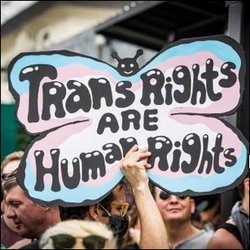


Nearly four in five Canadians (78%) say they have at least some knowledge of transgender, gender-diverse, and Two-Spirit people and issues. Almost half (45%) personally know someone who is transgender, gender-diverse, or Two-Spirit. Personal familiarity is associated with greater knowledge, stronger recognition of discrimination, and higher support for rights and legal protections.
Canadians express moderate comfort with having a transgender person as their neighbour (56%), working alongside a transgender colleague (54%), or having a transgender healthcare provider (48%), with 30%-37% indicating that they are “very comfortable.” A consistent proportion of roughly one-quarter are neutral and 24% or fewer are uncomfortable in each case.
In “Rising out of hatred,” Eli Saslow describes himself, and the whole white supremacy movement, as avoiding to say “We hate [group]” in favor of things like “We love our [minority] fam, but we all thrive best in our own community.” Essentially, they’re trading ‘kill all the [minorities]’ for ‘go be a [minority] somewhere I don’t have to see it.’ The mainstream can be more comfortable with it.
Even Abraham Lincoln started with that as the solution to slavery. He was able to learn that such isolation is hateful, oppressive, and not good for the long term, but I think it’s a hard lesson to communicate. Most of us gravitate to similar-minded, similar-culture people, and welcoming people with different social patterns or expectations can be uncomfortable.
We gotta do it, though: it’s the very definition of pluralism.