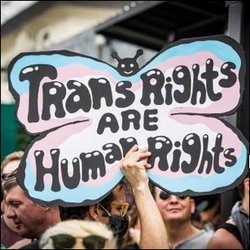


Nearly four in five Canadians (78%) say they have at least some knowledge of transgender, gender-diverse, and Two-Spirit people and issues. Almost half (45%) personally know someone who is transgender, gender-diverse, or Two-Spirit. Personal familiarity is associated with greater knowledge, stronger recognition of discrimination, and higher support for rights and legal protections.
Canadians express moderate comfort with having a transgender person as their neighbour (56%), working alongside a transgender colleague (54%), or having a transgender healthcare provider (48%), with 30%-37% indicating that they are “very comfortable.” A consistent proportion of roughly one-quarter are neutral and 24% or fewer are uncomfortable in each case.
It has absolutely nothing to do with professional athletes. People born XY are typically stronger, on average, than people born XX. Put both people in the same training program and you’re going to see a difference. That’s science. If you were born XX, you will (again, on average) have 50% less upper body strength and 30-40% less lower body strength than someone born XY. That does not mean both of you aren’t women. That does mean you are not the same. It’s the same reason a lot of coed leagues are non-contact.
You’re describing the difference between men vs women, not cis women vs trans women
I am describing the difference between both. Trans women used to be men. And as I said elsewhere, there are still differences.
I agree with and appreciate the sentiment (a performance advantage among AMAB trans women would not imply they are not women) but the science is not as settled as you’d think. Obviously, testosterone has a great effect on muscle development, force production, and explosive power. But the question is how much of that is retained after many years of HRT. Muscular atrophy definitely occurs, but how much muscle is actually retained if you’re training like an Olympian? we really don’t know! There simply aren’t enough elite trans athletes or general study among amateur athletes for a 1:1 comparison. And if the data comes back and implies there is an advantage, fine - but can we prove it’s greater than the other genetic advantages we just tend to accept? (height, reach, other myriad things you can just be born with an advantage for) If we really need to control for birth sex, shouldn’t we have a conversation about those other genetic physical advantages too?
Anecdotally, I’m a weightlifting coach and have trained all combinations of trans/cis men/women/etc. I have also participated in a coed HEMA league. The trans women I have trained and fought tend to passively have a little more strength as a beginner than the cis women I see, but they get stronger at about the same rate as cis women, plateau around the same point, and tend to have poorer mobility/control/proprioception. Ultimately I think that may speak to a disadvantage that tends to come with living a lot of life feeling disconnected from one’s body. That’s not every trans woman’s experience but it is for many.
I also wonder how much of the perceived advantage comes from a greater cultural expectation for people raised as men to cultivate strength and muscle mass, especially as kids and young adults. The broader point being, the data we have sits among so many complicating factors that we cannot yet reliably draw the conclusions you’re suggesting are long settled. Testosterone and birth sex cannot be ruled out of course, but it is not the whole picture.
You are absolutely right, of course, but the flip side of that is that the rest of the picture makes a lot of assumptions. Several big ones are just around HRT. For example, to pick a couple. When did they start taking it? For how long? Have they stopped? That adds a dynamic that can’t reliably be accounted for. And if they stop, well, the XY is going to start to take over again. And it’s not like that’s something that you can just ask someone.
Yeah, I don’t really know what the fair solution is myself - ultimately I think the performance of trans athletes is going to have much wider variation than the cis population. Any completely fair line would probably have trans women on both sides of it. (along with some cis people too) But I certainly couldn’t tell you where exactly to draw that line. Give me some time and funding and we could know more definitively :P
There are just so few trans athletes that even if we all had a big advantage, I cannot imagine us “taking over” in a way that leaves cis women unable to compete. At most there’d probably be a handful of trans women competing per league. For amateur sports I feel we could have divisions based not on gender but on performance, with people moving between divisions based on who they are most competitive with. You might still end up with mostly gendered divisions, but it’d be more flexible and able to account for a broader set of genetic advantages.
Honestly, I’d love to see more men and women in sports together, be they trans or not. There are some sports, like baseball, where I can’t see why that’s not already the case, even professionally. You certainly don’t need to be a CIS male to throw a 95 MPH fastball.
actually it can, although doing so precisely might be complicated
I’d be interested in learning how, other than violating someone’s medical privacy. While I myself am not trans I prefer to be informed.
i thought you meant accounted for in research
but for actual sports rules it probably should not be accounted for because medical privacy and because other things matter more making it quite redundant
Well, I mean, there does need to be accountability somewhere. Research would be ideal, but that’s not a settled science yet.
Well, the medical privacy issue is exactly why I wanted to know how it would be accounted for. Because in addition to the research not agreeing with itself, you still have the other assumptions I listed - like when they started HRT, how long they’ve been on it, if they’ve stopped. That’s not information you’re going to get without violating someone’s privacy, but that is information that will make a difference.
strength is based on hormone balance
someone whos been on hrt for a while will have the strength bias of whichever sex they hormonally are
Not all of the strength imbalance is hormonal, though. And if for some reason someone stops HRT before they should, what they were born with will take over.
this is underresearched
yes
hormone balance will revert, and so, over time, will muscle mass
I mean, the whole damn thing is underresearched, and what research is there on a lot of it tends to disagree with itself. That’s the problem. Thank you for at least entertaining what I do know and not jumping to “this guy is clearly transphobic”.