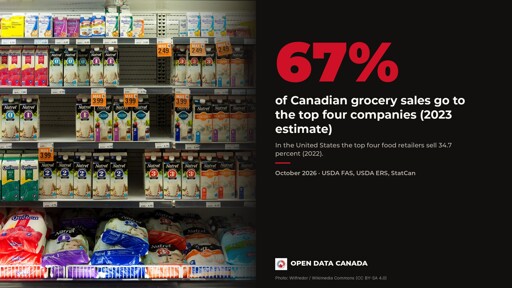
Loblaw, Sobeys, Metro and Costco sell about 67 cents of every dollar Canadians spend on groceries, by a USDA estimate. The four biggest US food retailers sell about 35 cents.
Canada has one of the most concentrated food systems in the industrialized world. Typically, when corporate concentration surpasses levels that generate “efficient” business activities, processes and products, then negative social and economic effects are produced. Beyond that level of concentration, firms are able to extract excessive profits and / or control entry into marketplaces, to the detriment of other firms. High levels of concentration also typically penalize suppliers, who receive lower prices for their goods relative to what they would receive in a more competitive environment. Consumers also pay more because sellers can charge higher prices for their goods in the absence of a base of competing sellers. There is some evidence that recent inflationary pressures are partly the result of tacit collusion amongst firms in highly concentrated sectors. The Competition Bureau (2023) concludes that low competition in the grocery sector has resulted in increased profits the last 4 years during inflationary pressures, sometimes referred to as seller’s inflation. There’s also evidence that concentration can suppress wages. Since the 1970s, around 10% of the wage stagnation in the United States is due directly and indirectly to buyer corporate concentration (e.g. Walmart and Amazon).
Canadians should consider that overly consolidated, corporate-controlled food systems are unstable.
Canada’s current food system lacks diversity, which makes it vulnerable to global supply chain disruptions. The mainstream system also enables a few food retail tycoons to achieve record-breaking profits, while Canadians experience growing food insecurity.
Discussions around the need for public alternatives should not focus solely on profit margins. We need to start thinking about food the way we think about roads or public transit — infrastructure that deserves public investment.
This shift will require Canadians to see food not simply as a commodity, but as a public good. Government-run stores are only part of the picture. There are already community-led alternatives across Canada worth paying attention to.
costco is surprising its so big in canada.
We don’t really have a good wholesale alternative. I think Loblaws has one but not many locations (at least in western Canada).
I respect Costco’s labour policies a whole lot more than any of those other ones anyway.
costco is one of those, that people stay a long time as a retail employee, thats why its pretty hard to get jobs at costco. most other chain/big bog store make it so unpleasant that you leave eventually.
Costco is legitimately a good place to work. When I worked there seasonally they had the pay raise schedule in the employee manual. There were people making $18/hour as cashiers in 2010.
in our area, its hard to get a costco job, because people dont leave, and there arnt any openings that a sane person would want, that tells you the company treats them good. in the STATES. we have 1 inner city costco, which is unique, since most costcos arnt near any cities.
Bruh that’s exactly why my position was seasonal. Brought me in for overnight stocking during Christmas season. Part time for 90 days. No permanent positions available after.
Even in 2010 it was obvious that a lot of lgbqt people had long term careers there. At least at that location.
Wow four whole supermarket chains? That’s double Australia, where we have just two.
I’d wager it’s more or less the same structural reasons as Canada though.
Canada was founded on careful, conservative protection of landed elites. So, yeah, same story.
This is simply the result of Canadian cities with overly anti-small business policies. The fact that you can’t just run a business anywhere, or that you require to have a license from the municipal/city, or even have a permit for a sign out on the street, have a permit for x style of signage, etc. all for the sake of the look-and-feel of a city… is anti-business. It puts barriers in front of lower budget mom/pop stores.
Go out of North America, and you’ll see that when overbearing policies are removed, small businesses thrive, cost of goods go down , and more variety are available to the consumer.
This extends beyond just the grocery market.
And you end up eating food fried in sewer oil. Or are constantly dodging signes and advertisements and panhandlers everywhere
Those are all reasonable and necessary restrictions though, not sure why you think they’re burdensome. Things like accessibility, traffic, public safety, etc are part of operating a business.
Part of operating a brick and mortar business yes, but digital is largely unregulated.
Brick and mortar then largely gets captured by large corporations and main Street gets hollowed out.
Public safety is important! But municipalities should be approving permits same day and making processes as simple as possible, and use standardized non bespoke rules.
Accessibility… also important! But there should be more carve outs for small operators. It’s one of those things that sounds nice but has actually caused things to be less accessible. Having an empty closed store front is the opposite of accessible.
100% this. A lot of local town regulation is implemented under a guise of community protection and wellbeing. Then in practise it displaces local businesses and replaces them with big corporate setups that can navigate the new rules more easily. They’ll fine someone for not installing a ramp, but not provide that same ramp to the local park.
Please read what I wrote again. I never said to discount accessibility, traffic, public safety, etc. It is the less obvious fees/policies that cities impose. Some are triggered only when a business changes hands.
But it also tells that many have no idea how much upfront money is required for these upgrades to get aging buildings into compliance and that’s when you haven’t even started selling anything. You need at least 500k of liquidity to just ‘start’ (if it’s anything like a small cafe as an example) and that amount won’t even last past 6 months given the nature of how consumer habits work in North America.
Add in the lack of trades in Canada, the price skyrockets - I mean, that’s a whole other story.
The silver lining in there is that people should be claiming tax credits/breaks where applicable. Many provinces and federal taxes for business have built-in incentives.
Be glad you’re not in New Zealand where “Competition is dominated by two major retailers” according to the New Zealand Commerce Commission Market study into the grocery sector Summary of Findings published March 2022.
2 or 4 - functionally equivalent. A market requires many many more to be efficient. We’re better off only in principle.
If you ever see an item in the grocery store that says “Prepared in Canada”, it means nothing of value, avoid them for their deceptive practices.
Depending on where you live there are likely farmers’ markets and/or local producers within a reasonable drive. In my experience it can range as far as price, and flavour is almost always better.
At least it’s a way to reduce reliance and dependence on this oligopoly.
And people in farmers markets have been caught just purchasing produce from the store and reselling it.
Just wanted to point out an iconic quote from BC Green Leader from tonight’s debate, said towards the other two candidates “Neither of you have the guts to stand up to Big Grocery and it shows”.
Bless Emily Lowan fr.
She’s so awesome.
Good on the BC Greens holding the BCNDP to account. You have the fed NDPs, Ontario NDPs, and the Toronto mayor all talking about local COOP groceries, while BC has an NDP government and aren’t.
The BC NDP is much closer to the federal liberals at this point IMO. Focus on fossil fuels and upholding the wealthy corporations that will “invest” in our natural resources (while actually its majority paid for with public dollars).
It’s very unfortunate, but just a sign that Eby either needs to gtfo or else will absolutely ruin the party.
Never heard of metro, but suppose I should respect save on foods more