

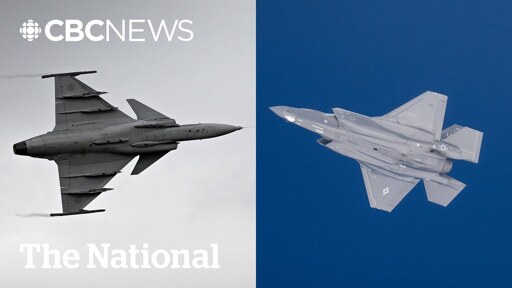
F-35 need to be repaired so often they can’t be used 50% of the time, and those repair parts come from a very unstable and hostile trading partner.
Seems like a no brainer to go Gripen given the current situation.
Not to mention parts from Israel too, a country that has killed Canadians with impunity
The major difference that they don’t cover is that the F-35 is designed, built and controlled by the United States, an adversary of Canada, already at economic war with Canada and with a declared objective to annex Canada and make it the 51st state of the United states, while the Gripen is designed, built and controlled by Sweden, a long standing ally of Canada with no hostile declarations or actions.
The Gripen is not controlled by Sweden since they offer to form our technician
If you mean Sweden will transfer the technology to Canada so that Canada can have full and independent control of them and even maintain and build them entirely in Canada if they choose, then that’s even better.
I think that’s the plan. Gripen will build a factory in Canada and form our technician. At least it was propose before the newest Trump’s tantrum
It seems that now they even proposed to transfer the software, and all servicing to be done in Canada, even for the engine (US made).
According to this brochure from SAAB:
GE Aviation will provide and sustain the fighter’s engines in Canada.
But that’s from 2021, so maybe the current proposal is for a US made engine.
This from 2026 says:
The Gripen E is based on an American engine (F414). This means dependencies on licenses and authorizations. In a context of sovereignty, this is a point that needs to be addressed, not circumvented.
I wonder if a Canadian or European made engine is still possible. I guess anything is, at some a cost.
Investing in any aircraft with critical components controlled by Canada’s greatest current threat seems a poor strategy.
Servicing of the engine would indeed be made in Canada: https://www.saab.com/markets/canada/press/saab-chooses-standardaero-to-maintain-gripen-engines-in-canada
You still need to purchase the engine and spare parts from GE.
I suppose Rolls Royce and Volvo could propose alternative engines, but I assume that’s as much dev, tests, certifications, so additional cost.
To my understanding, the plans for a Rolls-Royce engine have never moved forward and are not economical without a much larger market for the Gripens.
So… I don’t watch videos; anyone have a bulleted list?
The only ones I know about are the LM supply chain, US telematics control and US-centric command and control system on the F-35.
In essence, every F-35 sold is a part of the US Air Force one way or the other.
Gripen is more versatile for our north and for various mission types.
If equally skilled pilots faced off one-on-one, the F-35 would beat the Gripen.
The Gripen perks include supply chain and industrial benefits of making jets in Canada for other partners around the world, making it the better nation-building investment.
The F-35s are currently behind in production schedule to other international buyers, with no guaranteed deadlines, or that the contracted quantity and loadouts will be what actually gets delivered.
I didn’t watch the video, but from what I have heard, by itself, the F-35 is a dog. It would be nothing without the large scale computerized logistics system that it was designed to be a part of.
The Gripen was a state of the art air to air combat aircraft. …40 years ago.
The gen 4 Gripen would maybe lose.
The F-35 is a missle/sensor truck.
The in-planning Gen5 Gripen would almost certainly win.
You can’t hit what you cannot see.
The F-35’s radar and EOTS make it so it sees anything less stealthy than itself first.
If you can see first and shoot first, you win the BVR fight. Full stop.
Not that this matters since if F-35s and grippens are shooting one another, the western world has ended as we know it.
Either way, Canada needs a homeland defense fighter, not a “join in and be part of coalitions that fight away from its shores” fighter.
The downside of not having the F-35 is mostly in not being able to effectively fly the same 5th generation tactics, and be part of the same deployments as the countries using them.
In Canada’s case, I don’t see them forming an armed coalition with the US so… not much lost.
Canadian companies alledgedly played large roles in the development of the F-117 and the B-2, so we potentially have knowledge of weaknesses unannounced to the world.
Russia/China have claimed multiple times that the frequencies they use on their tech defeat US stealth coatings, but personally I question their truthfulness.
The only time I am aware of US tech fighting a peer was the defence of Kosovo, and the Serbs had no trouble shooting down an F-117. In the current Iran war, the US seems to only do sorties with overwelming airpower, so we don’t see stealth tech in action.
Man. This is why I shouldn’t engage in conversations with people on the internet. They think their uninformed ideas had in the moment behind a keyboard are equitable to people who have the head of the program’s business card on their desk.
The F-117 downing in Kosovo was due t mission planning failures. They flew the same routes, repeatedly, so the ground commander would know when and where to switch on radar as they opened their bomb bay doors. If you fly the same path at the same times you are going to get shot down when employing munitions. They also did have a very hard time defeating their effectiveness as it was the sole shoot down of the campaign in what was one of the most contested SAM airspace’s of the modern era.
That addressed, the technology in the have blue program is 20 years behind what originated the F-35 program. I have EOTS “glass” on my book shelf. I have written chapters of books on the plane, and had my hands inside the airframe. Believe me, it is not sensical to compare these things, nor does any knowledge of previous generations help you defeat it in the air.
When the US went to red flag the first time with F-35s, they scored a kill rate of 145 aircraft to 7 losses. This was with giving the enemy side a respawn protocol where they could fly back to a waypoint and then rejoin the the fight after dying to put further pressure on the F-35 blue team aircraft. It was a one sided slaughterhouse and all 7 kills on the F-45s occurred inside visual range. Literally nothing could beat it in beyond visual range combat.
This is an aircraft that can trap on a carrier deck at night in a storm automatically and did so in 27 repeated landings on a carrier during the program.
It has the most socialites data fusion of anything out there, letting it sort, weight, and analyze tract data from hundreds of sources simultaneously to then present the pilot with a singular picture. It supports complete off bore AICS shots with look through airframe capability, and an optical passive targeted suite that lets it detect adversary aircraft by the heat friction on their wings up to 35 miles away without radiating any energy limits own.
The radar when turned on can act as its own electronic warfare suite jamming, searching, and targeting hundreds of assets at once in both air and ground search. A ground based radar or AWACS, local other fighters, and even satellites can link to its sensor fusion package that automatically evaluates each piece of data to decide which is most correct to unify that display to the pilot without any pilot workload. This means you go from track to identify to target to shoot far faster than any other cockpit.
The F-35 even supports towed decoys to mimic a phantom airframe and lure missiles that do manage to target it. It is the single most advanced weapon to exist to date and the stealth piece of the puzzle is not its primary selling point.
It will see you, and shoot you down, before you can get a target lock on the airframe. By the time you detect it on search band radar you will be evading incoming missiles and it has already notched out of the fight and range of your missiles.
I cannot begin to illustrate how dominate the platform truly is in a short social media post.
All that however is irrelevant to the MISSION the Canadians need their air frame to fly. The budget point doesn’t justify the purchase for their lack of need of those features and being in bed with a bad actor government makes it worse.
As for utilization rate, during the above red flag exercise the airframes were at 90%.
The current CF-18s flown by Canada are at a 40% utilization rate and F-35As across the Air Force have a 48-55% utilization rate for single mission flight. Much of the limitations there are from the technology refresh 3 and 4 parts availability and service validation ongoing for retrofitting the older airframes to the TR3 and 4 hardware.
I will close by saying the Gripen is the best choice for Canada’s needs and budget and current geopolitical position, but comments like yours remind me how far remove most people behind a keyboard are from the aircraft.
Yeah fair.
The thing about the war games is an interesting one though.
The kill ratio you noted is only when the US networked systems are allowed to exist in full. Once you take it out of that role, which is the explicit role it is built for, it loses.
Again, comments without understanding coming from you.
The blue team of F-35s had only eachother to datalink to.
The red team had F-16, F-15s with AESA radar, ground stations, and targets that were part of the strike package target list.
The F-35 blue team had to defeat air to air defenders, who knew where they would be coming from, when, and had overwhelming numbers advantage. The red team still died in BVR combat before they saw the F-35s.
You certainly can’t see the F35 given they’re not delivered, and when they are, their availability is so low there’s few chance you’ll see them in the sky. /s
The Gripen is apparently quite a bit cheaper than the F-35, both in terms of what it costs to buy the plane and what it costs to keep it in the air.
I think the gripen has a shorter landing distance, more tuned to the arctic and is more repairable.
People need to tell their mps to order gripens.
A delta wing optimizes for raw interceptor performance but it isn’t necessarily a design well optimized for high energy turns without bleeding speed, which is one of the benefits of adding canards.
The F35, F22, F15 style fat wing brought back close to fat horizontal and vertical twin wings allows for less energy bleed (speed loss) at higher angles of attack.
The F35 is mildly stealthy and chock full of endless cost overrun.
We need diplomats. Not death machines.
I can only wish I were as much of an optimist as you are.
America has the strongest military and Canada and Greenland are on the chopping block.
Missile and drone program like Iran’s? Seems to work well enough against US air defences.
Cheaper and less training intensive!
We also have Ukrainian drone factories.
And are part of NATO. I think other members would side with Canada rather than the US if it came down to it.
And are part of NATO. I think other members would side with Canada rather than the US if it came down to it.
Honestly I wouldn’t count on NATO at all. At least not for actual milirary support even if they side with us. I think everyone realizes that going against the US in a hot war is likely some form of WWIII event and they’d rather throw this or that country under the bus.
Gripen has canards, which makes it look less cool. And really, isn’t that what matters?
This is the truth. As we’ve seen in Ukraine air battles are fought with drones now and manned jet aircraft just toss standoff munitions and bug out. Looking cool is their main role these days.
Delta wing ftw
@Sunshine a lot…